 Makkah Live
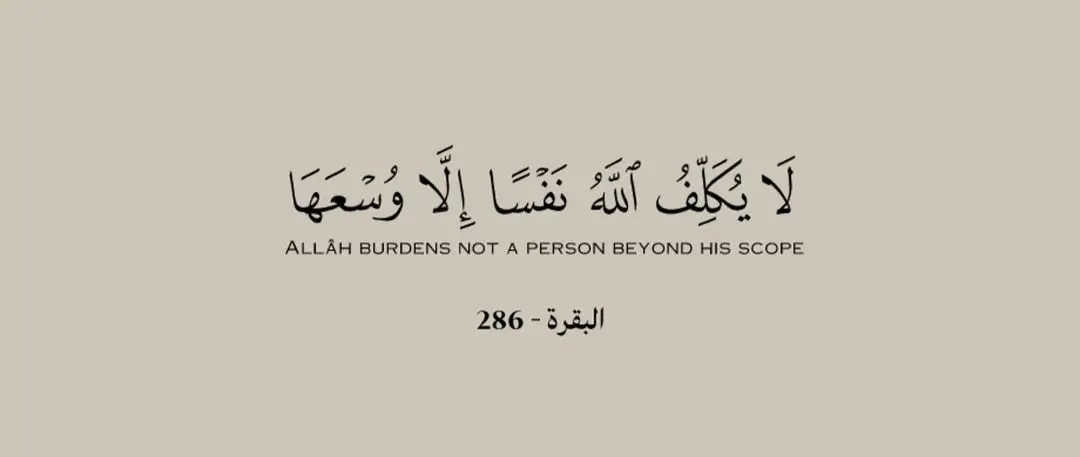
Allah does not burden a soul beyond what it can bear
Surah Al-Baqarah · verse 286 · the closing verse of the longest surah of the Quran
Font size
Transliteration
Lā yukallifu-llāhu nafsan illā wus‘ahā ۚ lahā mā kasabat wa ‘alayhā ma-ktasabat ۗ rabbanā lā tu’ākhidhnā in nasīnā aw akhṭa’nā ۚ rabbanā wa lā taḥmil ‘alaynā iṣran kamā ḥamaltahū ‘ala-lladhīna min qablinā ۚ rabbanā wa lā tuḥammilnā mā lā ṭāqata lanā bihī ۖ wa-‘fu ‘annā wa-ghfir lanā wa-rḥamnā ۚ anta mawlānā fa-nṣurnā ‘ala-l-qawmi-l-kāfirīn.
Meaning in English
“Allah does not burden a soul beyond what it can bear. It will have [the consequence of] what good it has gained, and it will bear [the consequence of] what evil it has earned. Our Lord! Take us not to task if we forget or fall into error. Our Lord! Lay not on us a burden such as You laid on those before us. Our Lord! Burden us not beyond what we have strength to bear. And pardon us, and forgive us, and have mercy on us. You are our Master — so help us against the disbelieving people.”
Recitation video
About this verse
«Lā yukallifu-llāhu nafsan illā wus‘ahā» — “Allah does not burden a soul beyond what it can bear” — is the opening of verse 286 of Surah Al-Baqarah, the very last verse of the second and longest surah in the Quran. With the verse before it (2:285) it forms what scholars call the Khawātim al-Baqarah — the closing verses of Al-Baqarah.
The verse is one of the greatest mercies in the Quran. It announces a principle that runs through the whole religion: every duty Allah places on you, every test He sends to you, has already been measured to the strength He has placed in you. The Sharia is not built on the breaking-point of the soul; it is built on its capacity — its wus‘ — what it can bear comfortably, with the help of its Lord.
The text shown above is the narration of Hafs ‘an ‘Asim, the reading used in most of the Muslim world, in the Uthmani script that follows the Madinah mushaf.
Why was this verse revealed?
It is reported in Sahih Muslim from Abu Hurayra (may Allah be pleased with him) that when the verse before it was revealed — “To Allah belongs whatever is in the heavens and whatever is in the earth, and whether you reveal what is in your souls or hide it, Allah will call you to account for it” (2:284) — the Companions found it very heavy on themselves. They came to the Prophet ﷺ, fell to their knees, and said: “O Messenger of Allah, we have been burdened with deeds that we cannot do — the prayer, the fast, jihad and charity we can do; but the thoughts of the heart — who can control those?”
The Prophet ﷺ told them to say: “We hear and we obey.” Then Allah revealed «Allah does not burden a soul except [with what is within] its capacity» — and forgave them what was said in their hearts that they did not act upon. From that day, the believer’s heart could rest: Allah was not going to ask of them what could not be borne.
The meanings of the verse
لَا يُكَلِّفُ ٱللَّهُ نَفْسًا إِلَّا وُسْعَهَا
“Allah does not burden a soul beyond what it can bear.” Whatever Allah commands you to do is within your capacity. Whatever trial He sends you, He has already given you the strength to face it. If a duty becomes truly impossible — a sick person who cannot stand in prayer, a traveller who cannot fast — the Sharia eases it. Allah does not ask of the soul more than its wus‘ — its comfortable capacity.
لَهَا مَا كَسَبَتْ وَعَلَيْهَا مَا ٱكْتَسَبَتْ
“It will have what good it has gained, and it will bear what evil it has earned.” Each soul is held accountable only for its own deeds — no one bears the burden of another. The reward of every good act is yours; the consequence of every wrong is on you alone.
رَبَّنَا لَا تُؤَاخِذْنَآ إِن نَّسِينَآ أَوْ أَخْطَأْنَا
“Our Lord, take us not to task if we forget or fall into error.” A plea for Allah to overlook what was done in forgetfulness or unintended mistake. It is established in the hadith that “Allah has lifted from my Ummah error, forgetfulness, and what they are forced to do” — and this verse is the believer’s plea that this mercy be sustained.
رَبَّنَا وَلَا تَحْمِلْ عَلَيْنَآ إِصْرًۭا كَمَا حَمَلْتَهُۥ عَلَى ٱلَّذِينَ مِن قَبْلِنَا
“Our Lord, lay not on us a burden such as You laid on those before us.” The earlier nations had heavier rulings — covenants and laws that this Ummah was spared. The believer asks that the path of this Ummah remain the path of ease that the Prophet ﷺ was sent with.
رَبَّنَا وَلَا تُحَمِّلْنَا مَا لَا طَاقَةَ لَنَا بِهِۦ
“Our Lord, burden us not beyond what we have strength to bear.” A second plea: not just that the duties be light, but that the trials of life — sickness, loss, fear — also be measured to what we can carry.
وَٱعْفُ عَنَّا وَٱغْفِرْ لَنَا وَٱرْحَمْنَآ
“And pardon us, and forgive us, and have mercy on us.” Three pleas in succession, each deeper than the last. Pardon — that Allah erase the trace of the sin. Forgive — that He cover it so it is not exposed. Mercy — that He bring the heart back to Him after it has strayed. The believer asks for all three.
أَنتَ مَوْلَىٰنَا فَٱنصُرْنَا عَلَى ٱلْقَوْمِ ٱلْكَٰفِرِينَ
“You are our Master — so help us against the disbelieving people.” The verse closes by declaring tawhīd of dependence: it is You alone, O Allah, who are our Master, our Protector, our Helper. Help us against every people who reject You and oppose Your religion. With this declaration the longest surah of the Quran ends.
When is this verse recited?
- At night with verse 285 — the Prophet ﷺ said: “Whoever recites the last two verses of Surah Al-Baqarah at night, they will be sufficient for him.” (Reported by Al-Bukhari and Muslim.)
- In moments of difficulty — as a reminder that whatever Allah has decreed is within your capacity to bear.
- In witr and qiyam al-layl — many imams close their night prayer with these verses for their immense weight and mercy.
- In personal supplication — the dua at the end of the verse is one of the most beloved supplications of the believers.
Frequently asked questions
What does "Allah does not burden a soul beyond what it can bear" mean?
It means that Allah, in His perfect mercy and justice, never asks of a person more than what is within their capacity. Every command of the Sharia, every test, every responsibility — all of it is matched to the strength He has placed in the servant. If a duty exceeds your strength, it is lifted from you; the obligation is replaced with something easier, or the responsibility is removed entirely. This verse is one of the greatest mercies in the Quran for the believer.
Where is this verse in the Quran?
It is verse 286 of Surah Al-Baqarah — the very last verse of the second and longest surah of the Quran. With verse 285 it forms the "Khawatim Al-Baqarah" (the closing verses of Al-Baqarah).
When was this verse revealed?
It is reported in Sahih Muslim from Abu Hurayra (may Allah be pleased with him) that when the verse «To Allah belongs whatever is in the heavens and whatever is in the earth, and whether you reveal what is in your souls or hide it, Allah will call you to account for it» (2:284) was revealed, the Companions found it heavy on themselves. They came to the Messenger of Allah ﷺ and said: "O Messenger of Allah, we have been burdened with deeds that we cannot do." The Prophet ﷺ said: "Do you wish to say what the People of the two Books before you said: 'We hear and we disobey'? Rather, say: 'We hear and we obey, our Lord, [we seek] Your forgiveness, and to You is the destination.'" Then Allah revealed «Allah does not burden a soul except [with what is within] its capacity…» — and Allah forgave them what was said in their hearts that they did not act upon.
Why is this verse such a comfort for believers?
Because it is the answer to one of the deepest fears of the heart: "What if Allah asks of me more than I can bear?" This verse closes that fear forever. Whatever Allah commands you to do, He has already given you the strength for it. Whatever trial He sends you, He has already given you the patience for it. As Ibn Kathir said in his tafsir: "Whatever cannot be borne is not asked of the servant."
What is the supplication ("dua") that comes after this part of the verse?
After "Allah does not burden a soul beyond what it can bear," the verse continues with one of the most beloved supplications of the believers: "Our Lord! Take us not to task if we forget or fall into error. Our Lord! Lay not on us a burden such as You laid on those before us. Our Lord! Burden us not beyond what we have strength to bear. And pardon us, and forgive us, and have mercy on us. You are our Master — so help us against the disbelieving people."
What is the virtue of reading the last two verses of Al-Baqarah at night?
It is established in Sahih al-Bukhari and Muslim from Abu Mas‘ud al-Ansari (may Allah be pleased with him) that the Prophet ﷺ said: "Whoever recites the last two verses of Surah Al-Baqarah at night, they will be sufficient for him." The scholars have explained "sufficient" to mean: sufficient against the Shaytan, sufficient as the night-prayer for one who is unable, and a protection for him until morning.
How is "wus‘aha" (وُسْعَهَا) understood by the scholars?
"Wus‘aha" is from "wus‘", meaning capacity, scope, or what one is able to bear with ease. The verse uses this word — not "ṭāqa" (utmost effort) — to teach the believer that Allah's commands are matched to comfortable capacity, not the limit of breaking. As Ibn ‘Ashur said, the Sharia is built on what the average soul can sustain without exhaustion.
Is this verse only for hardships, or also for daily life?
For both. Every commandment of the religion — the prayer, the fast, zakat, hajj, kindness to parents, restraint of the tongue — falls within the capacity Allah has given you. And every trial, every loss, every difficult day — that too has been measured to your strength. Whoever reflects on this verse finds patience for the test in front of him and confidence in the path Allah has set for him.
Related links
- Khawatim Surah Al-Baqarah — the closing verses of Al-Baqarah (285–286) recited every night
- Ayat Al-Kursi — the greatest verse in the Book of Allah
- Surah Al-Fatihah — full text — Mother of the Book and the greatest surah in the Quran
- Surah Al-Mulk — full text — recommended to read every night before sleep
- Morning & Evening Adhkar — MP3 collection
- Saudi Quran Radio